
The Fraud-Cyber Convergence Blockers That Aren’t Actually Blocking Fraud Performance
We recently published a landmark study with Liminal on fraud-cyber convergence and how more converged organizations are enjoying a fraud decisioning precision advantage — 3.4x more dollars approved per dollar of fraud chargeback lost — over organizations whose fraud and cybersecurity teams still operate in silos.
We also learned that fraud-cyber convergence is almost universally a priority across these 250 organizations spanning retail/e-commerce, travel, entertainment and media, marketplaces, and quick service restaurants. 94% of respondents describe it as either a formal program with milestones or a recognized strategic priority. Given it’s of such high importance to achieve fraud-cyber convergence and alignment, we also asked what they perceived to be the drivers and blockers of convergence.
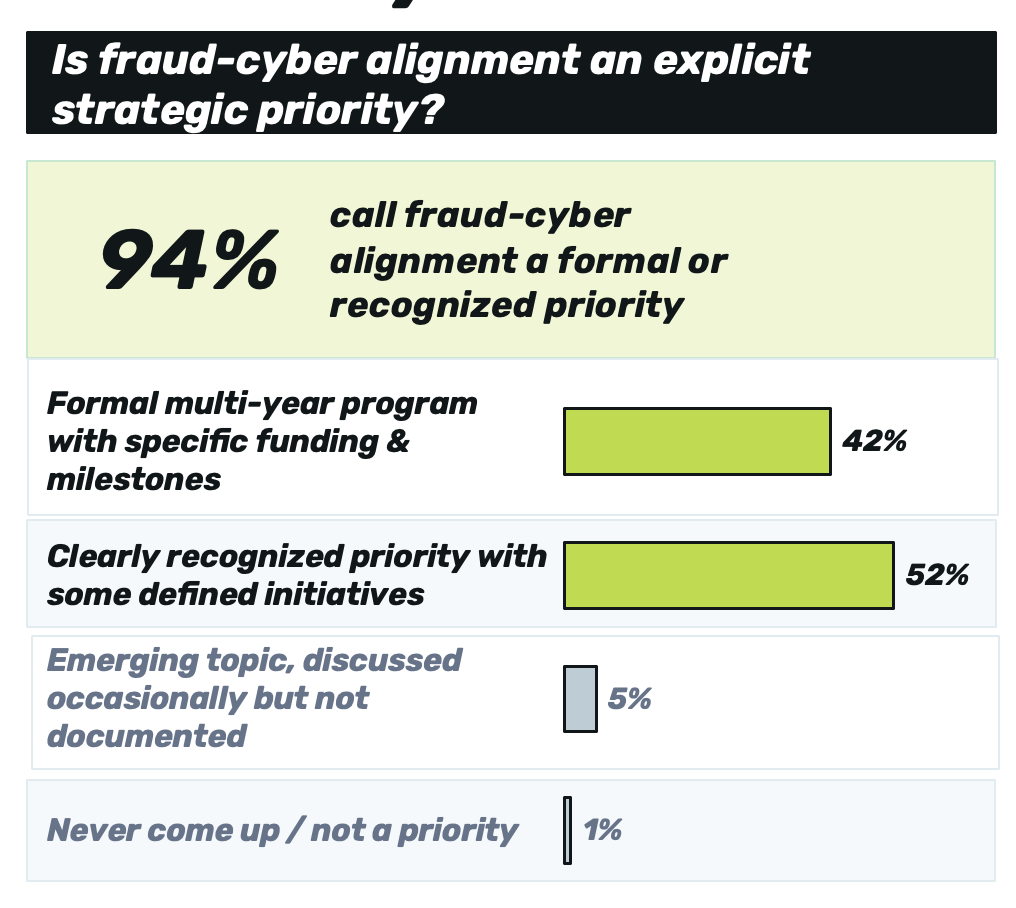
Here’s what they cited most often as convergence blockers: separate budgets for fraud and cybersecurity, and lack of shared visibility across systems. It turns out, they’re only half right.
Two blockers, tied for first
Both blockers were cited by exactly the same share of respondents: 46% named separate budgets, and 46% named lack of shared data or visibility.
When we tested each perceived blocker against actual fraud decisioning performance — legitimate dollars approved for every dollar lost to fraud chargeback, the study’s primary precision metric (the Precise Yes Score, or PYS) — only one of them held up. This led us to bust some “myths” about what prevents fraud and cyber teams from more effectively converging.
Myth: Separate budgets
Reality: Separate budgets don’t affect fraud decisioning precision.
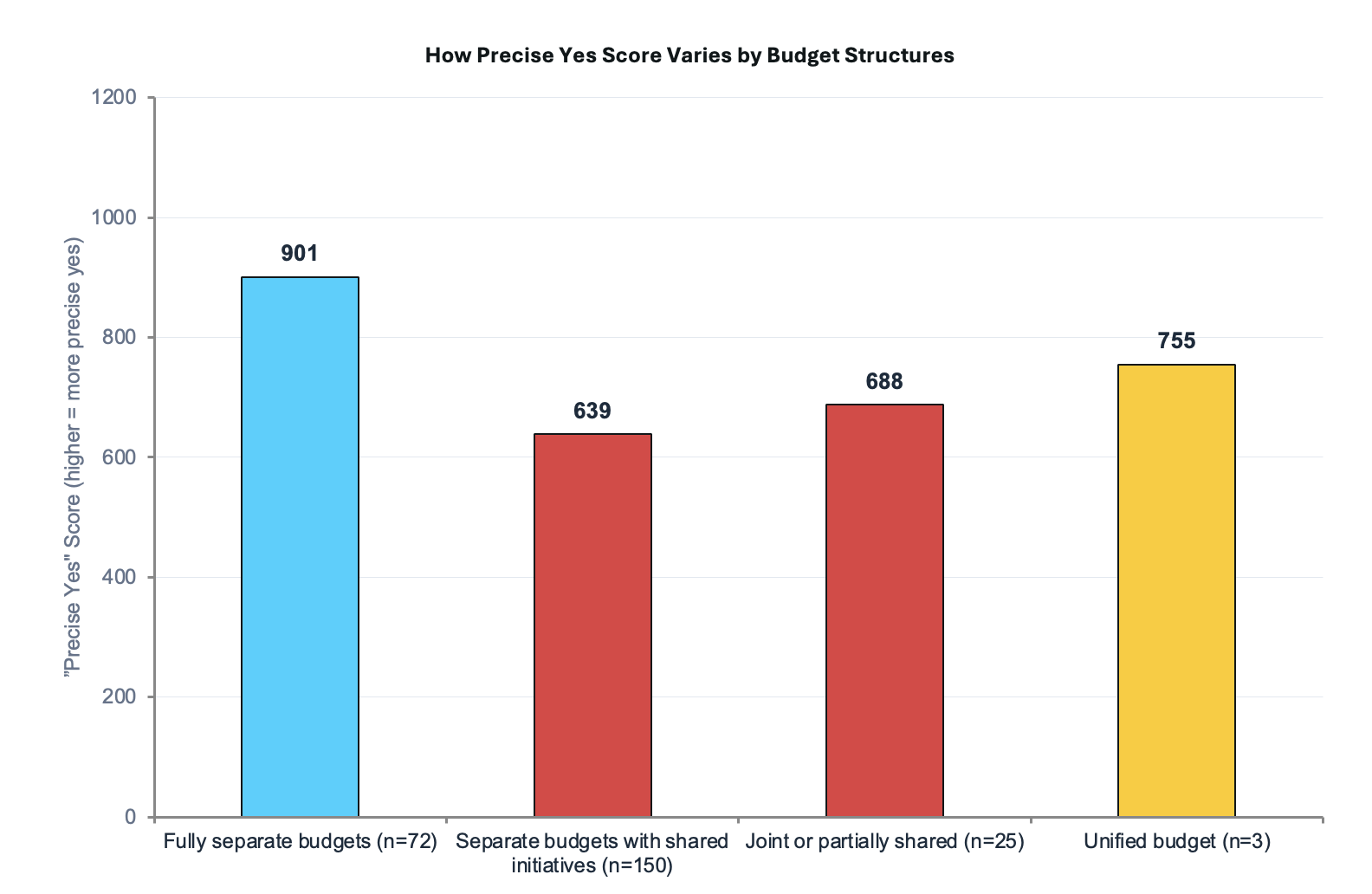
In the study, we gave respondents 5 choices to the question: How are budgets for fraud prevention and cybersecurity managed today?
- Fully separate budgets
- Separate budgets with some shared initiatives
- Joint planning with partially shared budgets
- Unified budget under a single owner
- Not sure — but no one chose this option
We then looked at how each of these groups performed on the precision metric:
| Budget structure | n | Mean Precise Yes Score |
|---|---|---|
| Fully separate budgets | 72 | 901 |
| Separate budgets with some shared initiatives | 149 | 639 |
| Joint planning with partially shared budgets | 25 | 688 |
| Unified budget under a single owner | 3 | 756 |
Organizations with fully separate fraud and cybersecurity budgets are not worse off than organizations that have unified them — in fact, the fully separate budgets are performing better (although the difference is not statistically significant). So if your teams are stuck arguing over whether to merge budget lines before they can move forward on anything else, they’re focused on the wrong thing. Merging fraud and cyber budgets may smooth internal workflows, but it’s not going to measurably change performance.
Myth: Data-sharing complaints are just more of the same
Reality: This is one blocker the data actually backs up — it’s true that lack of shared visibility across systems DOES reduce fraud decisioning performance.
Unlike budget structure, how fraud and cybersecurity teams share data is one convergence behavior that does significantly impact an organization’s Precise Yes Score. Organizations that move from siloed or ad hoc data sharing to integrated or fully unified data see it show up in their Precise Yes scores.
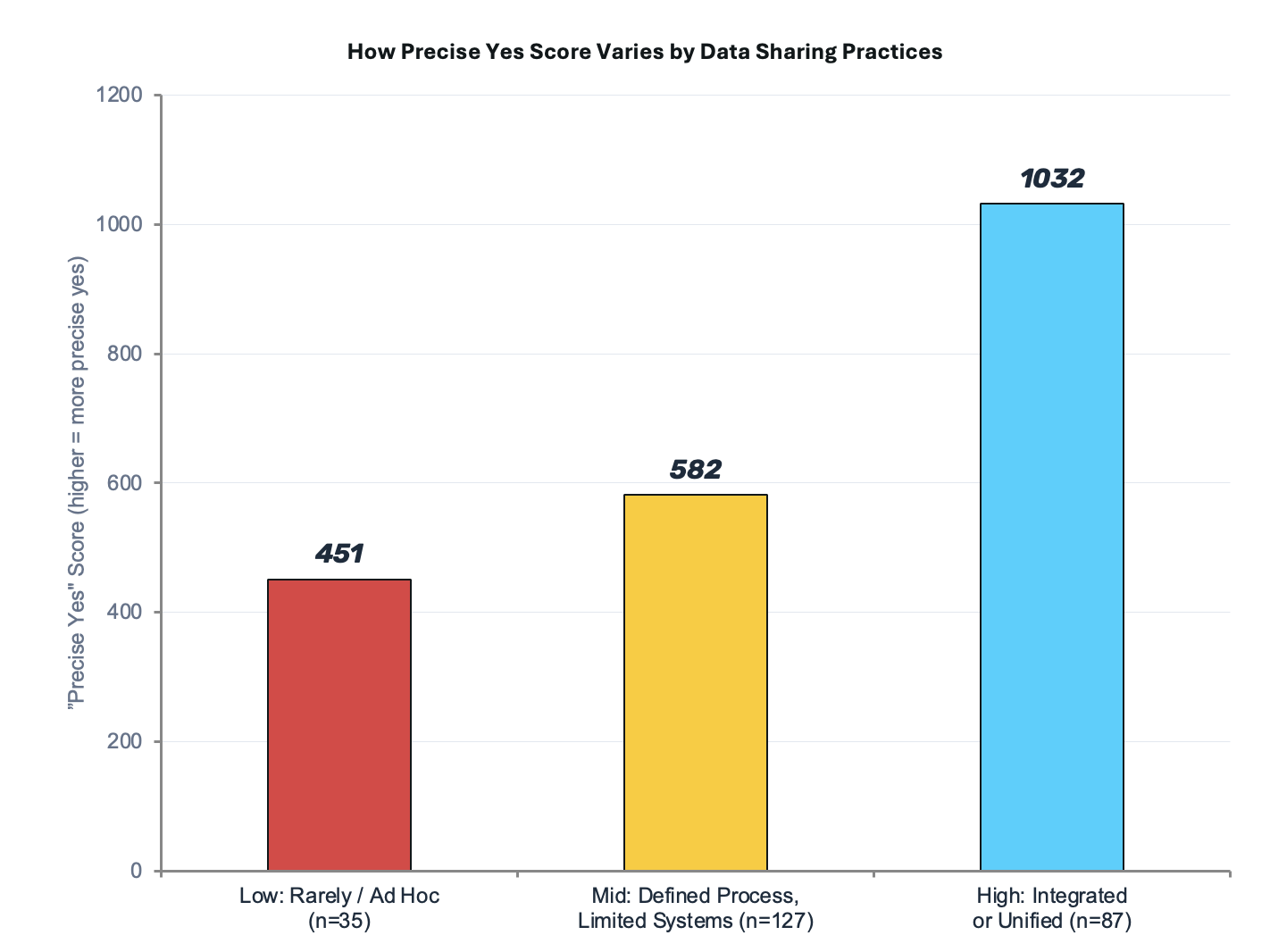
| Data sharing status | n | Mean Precise Yes Score |
|---|---|---|
| Integrated or fully unified data | 87 | 1,032 |
| Siloed or ad hoc data sharing | 162 | 554 |
So when 46% of respondents point to data visibility as a blocker, they’re not wrong. When another 46% point to separate budgets, they’re pointing at the wrong target.
Myth: A formal, funded program beats a “recognized priority”
Reality: How formally convergence is documented doesn’t move the needle either.
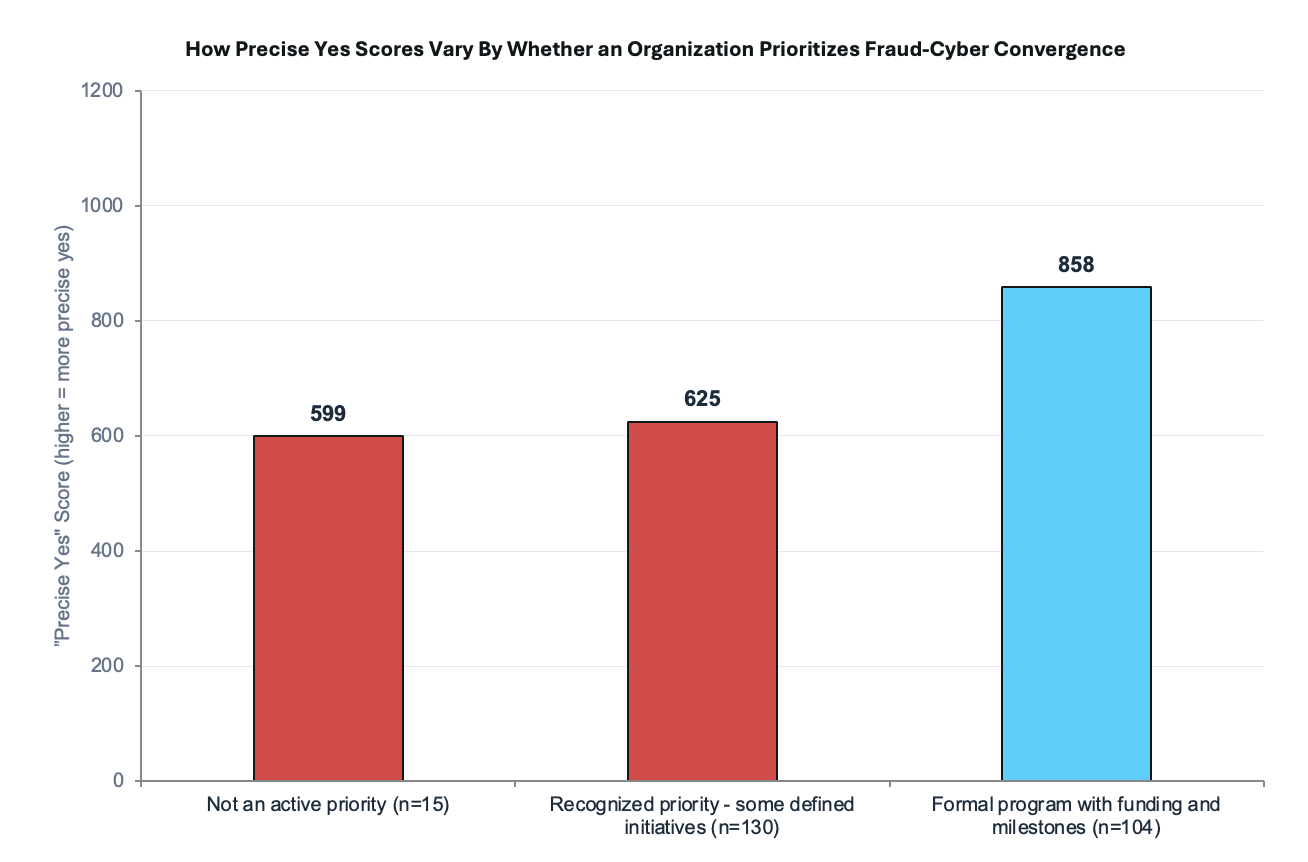
We also tested strategic priority as a driver of fraud decisioning performance, comparing organizations with a formal, funded, multi-year alignment program against those where convergence is simply a “clearly recognized priority with some defined initiatives,” no formal program required. While it may look in the chart below like formal programs outperform recognized priorities (858 vs. 625), this difference is not statistically significant (p=0.64) — meaning there’s a 64% chance this difference is due to random variation.
| Strategic priority level | n | Mean Precise Yes Score |
|---|---|---|
| Formal multi-year program with funding and milestones | 105 | 858 |
| Clearly recognized priority with some defined initiatives | 130 | 625 |
The takeaway isn’t that formal programs hurt. It’s that the formality itself isn’t what’s driving the outcome.
What this means if you’re trying to improve your organization’s precision in fraud decisioning
Fixing the things people complain about loudest isn’t the same as fixing the things that actually impact performance. Based on this data, the blocker most worth spending political capital on is the one tied to a pillar that actually drives more revenue per dollar lost to fraud chargebacks: integrating data onto a single platform or pipeline for both fraud and cyber teams to use — not budget consolidation or creating a formal fraud-cyber convergence program.
FAQ
Does separate budgeting between fraud and cybersecurity teams hurt fraud prevention performance?
No. Across 250 surveyed organizations, budget structure (fully separate, partially shared, or unified) showed no statistically significant relationship to Precise Yes Score (p=0.19).
What is the most commonly cited blocker to fraud-cybersecurity alignment?
Two blockers tie for the most commonly cited: separate budgets and lack of shared data or visibility across systems, each named by 46% of respondents.
Does a formal, funded convergence program outperform an informal but recognized priority?
No. There is no statistically significant difference in fraud prevention performance (as measured by the Precise Yes Score) between organizations with a formal multi-year program and those where alignment is simply a recognized priority (p=0.64).
Does data sharing between fraud and cybersecurity teams affect fraud prevention performance?
Yes. Data sharing is one of the few factors in this research that significantly predicts Precise Yes Score (p=0.005), unlike budget structure or program formality.
Source: The Convergence Dividend: Quantifying What Fraud-Cyber Convergence Actually Delivers, Accertify + Liminal, 2026. n=250.

Mare Yu
Chief Marketing Officer