
Fraud Prevention Platforms for Quick Service Restaurants: What the Data Actually Shows in 2026
The best fraud prevention platforms for quick service restaurants (QSR) are the ones built to unify fraud and cybersecurity signal at the login and account layer, not just at checkout. According to The Convergence Dividend: Quantifying What Fraud-Cyber Convergence Actually Delivers (Accertify + Liminal, 2026), a study of 250 fraud and risk decision-makers across five verticals, 68% of QSR respondents cite bot/credential stuffing as a top discussed threat — 16 points above the non-QSR average (52%). The threat is concentrated at login, and QSR’s platform investment isn’t fully matching up in the one place it’s needed most.
Quick Answer: What Should a QSR Fraud Platform Actually Do?
- Prioritize network/IP intelligence and identity & authentication signals — the two leading fraud signals in QSR, used by 70% and 68% of fraud teams respectively.
- Cover loyalty and promo abuse, QSR operators’ top two use cases for a unified platform (62% and 60%).
- Close the gap on bot detection — the least-used signal in QSR fraud stacks at just 6% of QSR fraud teams, despite bot/credential stuffing being the vertical’s #1 threat.
- Support shared fraud/cyber ownership, since QSR already leads every vertical on structural integration (48%) and CISO ownership (34%).
QSR’s Threat Profile Is Skewed Toward Login, Not Payment
QSR’s fraud problem is skewed toward bot/credential stuffing. Payment fraud (CNP) is a close second and roughly in line with the rest of the industry. Account takeover — the defining threat for Retail/eCommerce — is not top of mind for QSR.
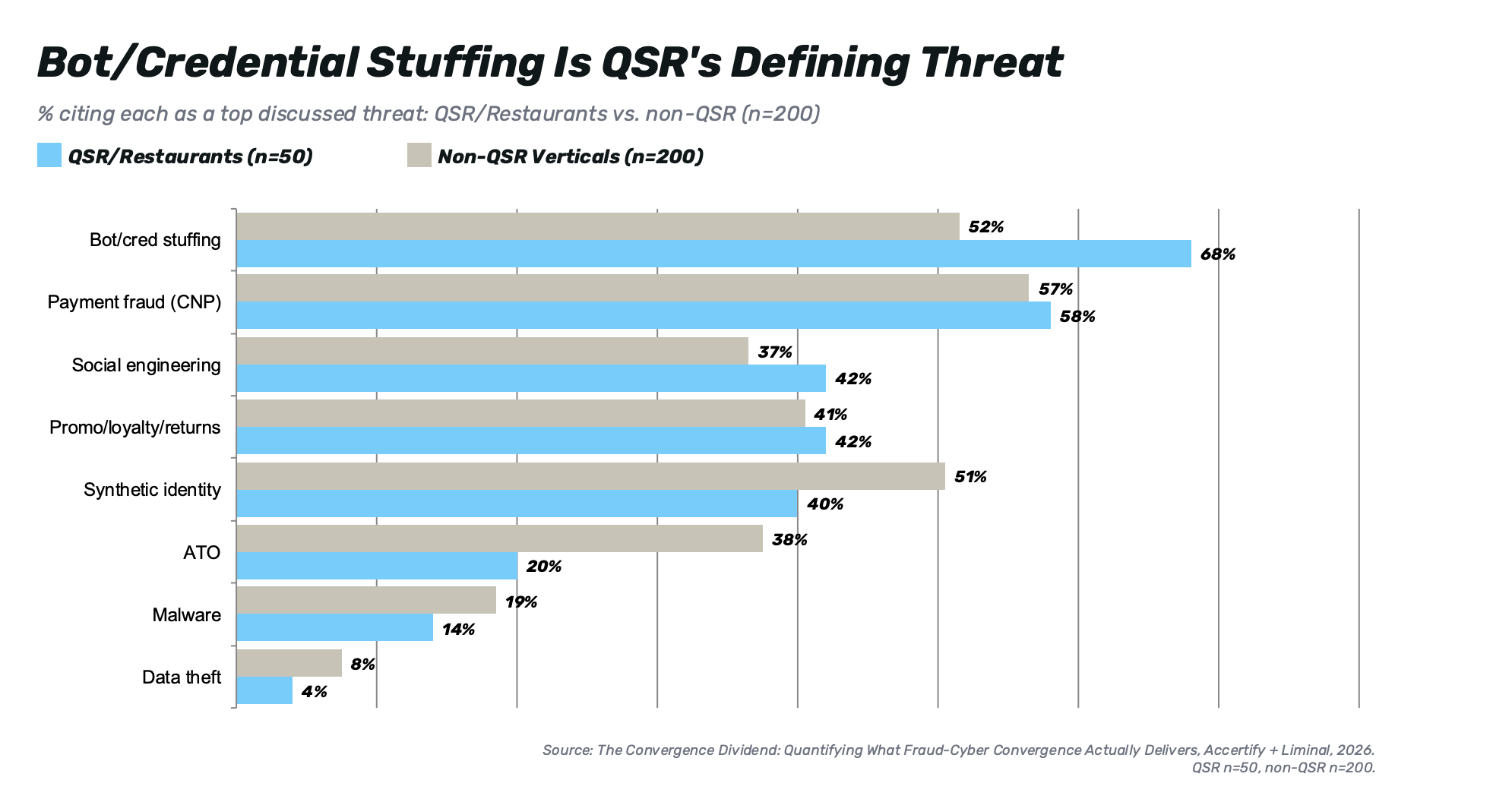
QSR’s top point of control today is account login (38%), and 84% of QSR operators are actively expanding controls there.
The Gap: QSR’s Own Platform Priorities Don’t Match Its Own Threat Data
When asked where a unified fraud-cyber platform would deliver the most advantage, QSR operators put credential stuffing dead last — below even the non-QSR rate (9.5%):
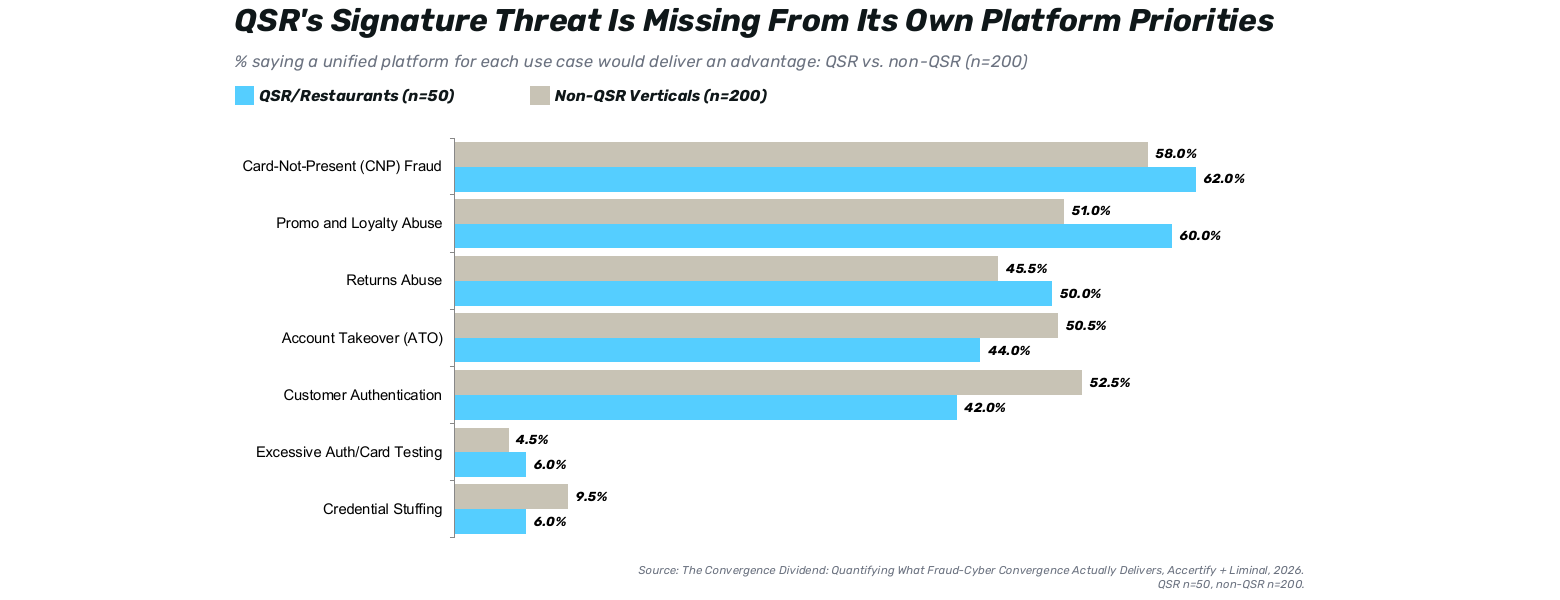
An operator scoring vendors mainly on CNP and loyalty/promo abuse coverage — the two things QSR operators say they want — is evaluating against a threat model that doesn’t match their stated exposure. Credential stuffing capability is the item most likely to be missing from the RFP, precisely because it’s not what QSR operators are asking for yet.
QSR Looks Converged on Paper…But Median Performance Tells a Different Story
Raw fraud metrics look nearly identical across all five verticals in the study — approval rates from 97.5% to 98.2%, fraud chargeback rates from 15.9 to 24.9 bps. That’s exactly the problem the study’s “Precise Yes” Score (PYS) was built to solve: approval rate divided by fraud chargeback rate, or dollars approved per dollar lost to fraud. It measures how precisely an organization says yes, not just how often.
QSR leads every vertical on the visible markers of convergence maturity: 48% partially or fully integrated structure (highest of any vertical), 34% CISO ownership (highest), 46% “tightly aligned” solutions (20 points ahead of #2). But PYS tells a more complicated story:
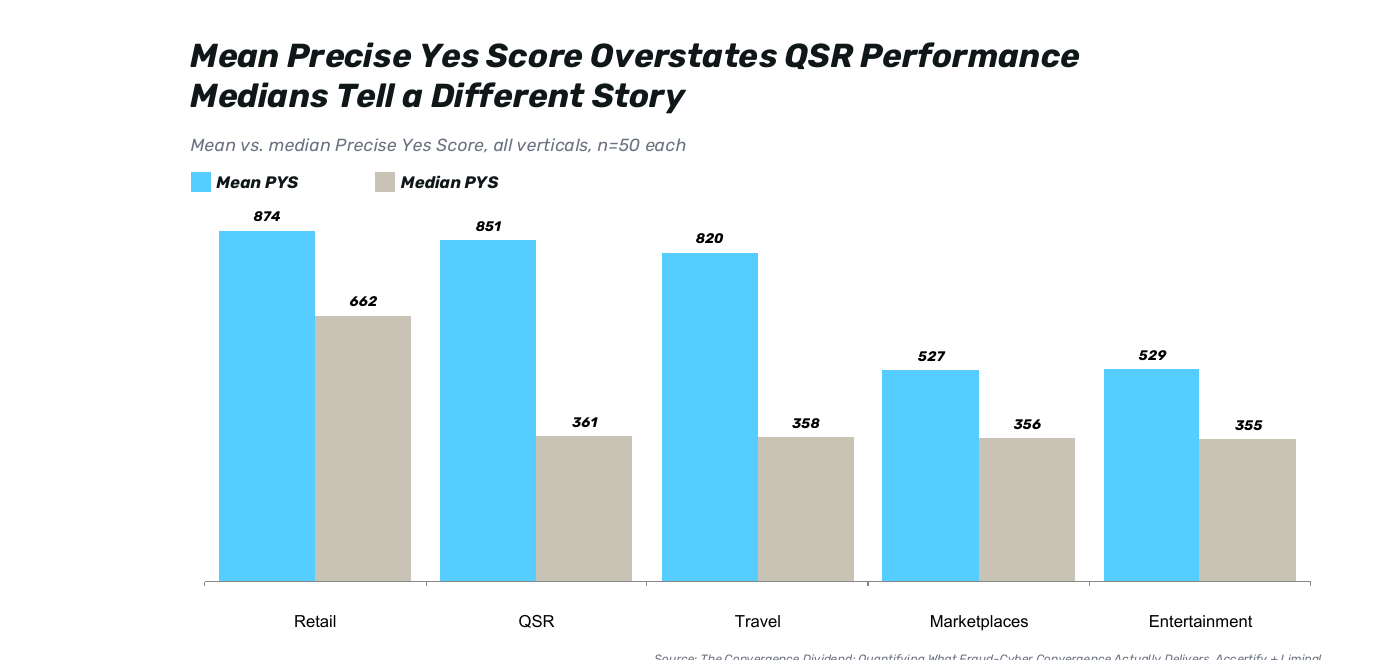
That gap is driven by a handful of outlier organizations, not by QSR systematically outperforming. The typical QSR operator’s fraud precision looks unremarkable once outliers are removed.
QSR’s Fraud-Cyber Convergence Is Reactive, Not Strategic
QSR’s top two convergence drivers are budget/tool consolidation and a major incident or breach — both cited by 40%, well above non-QSR rates (30.5% and 29%). AI/automated fraud, by contrast, is QSR’s lowest-ranked driver (14% vs. 26.5% non-QSR) — even though bot-driven credential stuffing is the vertical’s most-cited threat. QSR is converging in response to cost and crisis, not in response to its own threat data.
What This Means If You’re Evaluating a Fraud Platform for a QSR Brand
- Don’t evaluate vendors purely on checkout/payment fraud capability. QSR’s real exposure is at login and account changes.
- Ask specifically how a platform handles bot/credential stuffing detection, not just loyalty and promo abuse.
- Structural integration is necessary but not sufficient. Look for platforms and processes that support shared use-case ownership and unified data before — or alongside — formal org-chart integration.
- Cost per fraud investigation in QSR runs $298 on average, the highest of any vertical (vs. $169 in Retail) — which makes precision, not just detection volume, the metric that matters.
The Full Picture
This is a summary of a handful of findings in Converged on Paper: Fraud and Cybersecurity in Quick Service Restaurants, a QSR-specific breakout of the 2026 Accertify + Liminal study The Convergence Dividend, based on a 50-operator QSR sample within a 250-respondent study spanning five verticals.
The full report includes the complete threat and signal breakdown, QSR’s performance by convergence maturity tier, agentic-commerce readiness data, and the four-pillar convergence framework that predicts a 3.4x difference in fraud precision between the highest- and lowest-maturity organizations.
Download the full QSR report — free, no form required →
FAQ
What is the biggest fraud threat facing quick service restaurants?
Bot and credential stuffing attacks, cited by 68% of QSR fraud and risk decision-makers as a top discussed threat — 16 points above the average across other verticals.
Is account takeover a major concern for QSR brands?
Less than for other industries. ATO registers at just 20% in QSR, the lowest of any vertical in the 2026 Accertify + Liminal study, compared to 38% across non-QSR verticals.
Do QSR brands need a different fraud platform than retailers?
The data suggests yes, at least in emphasis. QSR’s fraud is concentrated at account login and account changes rather than checkout, and its signature threat (bot/credential stuffing) is underrepresented in what QSR operators currently prioritize for unified platform investment.
What is the “Precise Yes Score”?
A metric from the Accertify + Liminal study calculated as approval rate divided by fraud chargeback rate, representing dollars approved per dollar lost to fraud.
Source: The Convergence Dividend: Quantifying What Fraud-Cyber Convergence Actually Delivers, Accertify + Liminal, 2026, n=250 (QSR/Restaurants sample n=50).

Maryling Yu
Chief Marketing Officer